
Affiliate marketing stands as one of the most scalable performance-based business models in the global digital economy. By allowing individuals and publishers to earn commissions by promoting products or services created by third-party merchants, affiliate marketing aligns incentives across content creators, consumers, and brands.
For creators and publishers, affiliate marketing offers a path to build recurring, high-margin revenue streams without the capital-intensive burdens of product development, inventory management, or post-sale customer support. For merchants, it provides a low-risk customer acquisition channel where marketing dollars are spent only when verifiable sales or leads occur.
Mastering affiliate marketing in 2026 requires understanding the underlying ecosystem, selecting lucrative niches, building search engine optimized (SEO) content funnels, and leveraging modern tracking technologies.
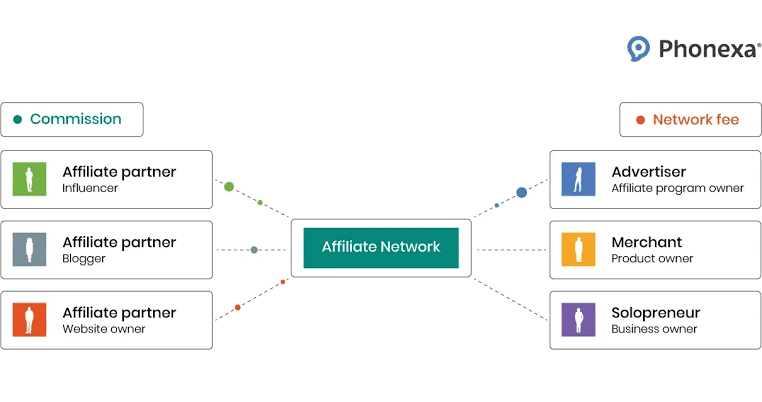
Core structure of the affiliate marketing ecosystem. Source: Phonexa
1. What Is Affiliate Marketing and How Does It Work?
Affiliate marketing is a revenue-sharing arrangement in which an online retailer (merchant) pays a external website or content publisher (affiliate) a commission for sales, traffic, or leads generated through the affiliate’s dedicated referral tracking links.
The Four Pillars of the Affiliate Ecosystem
The operational mechanics of affiliate marketing rely on four primary stakeholders working in tandem:
- The Merchant (Advertiser/Seller): The creator or vendor of the product or service. Merchants range from solo e-commerce entrepreneurs to multinational enterprise brands (such as Amazon, Nike, or SaaS platforms like HubSpot).
- The Affiliate (Publisher/Marketer): The entity attracting and educating target consumers. Affiliates create digital content—such as blog posts, software comparison tables, YouTube video reviews, and email newsletters—embedded with unique tracking links.
- The Affiliate Network (Middleware/Platform): The intermediary managing product catalogs, link generation, click tracking, attribution modeling, payment processing, and campaign compliance. Major networks include Impact, CJ Affiliate, ShareASale, Awin, and Rakuten Advertising.
- The Consumer: The end-user who clicks the affiliate link and completes a qualifying action (e.g., purchasing a product or filling out a lead form). Consumers rarely pay higher prices through affiliate links; in fact, they often receive exclusive promo codes or bonuses.
Technical Mechanics: Tracking Cookies and Pixel Attribution
When a consumer clicks an affiliate link, a small text file called a cookie (or a device fingerprint/first-party tracking token) is stored in their browser. This cookie contains crucial metadata:
- Affiliate Identification (ID): Maps the referral directly to the publisher’s account.
- Merchant ID: Identifies the merchant platform handling the inventory.
- Cookie Duration (Lookback Window): The time window during which a transaction qualifies for a commission (e.g., 24 hours for Amazon Associates, 30 days for typical SaaS products, or 90 days for high-ticket courses).
When the user completes a purchase on the merchant’s site before the cookie expires, the checkout system fires a conversion tracking pixel that awards the commission to the referring affiliate.
2. Payout Models in Affiliate Marketing
Different industries and merchant goals dictate how affiliate commissions are calculated and paid out.
- Cost Per Acquisition / Cost Per Sale (CPA / CPS): The most common model, where the affiliate earns a fixed flat dollar amount or a percentage of the total transaction value whenever a user makes a purchase.
- Cost Per Lead (CPL): The affiliate receives a commission for every qualified lead submitted, such as filling out an insurance quote form, requesting a software demo, or downloading a whitepaper.
- Recurring / Lifetime Commissions: Common in Software-as-a-Service (SaaS) and membership platforms. The affiliate earns an ongoing percentage (typically 15% to 40%) of the customer’s monthly or annual subscription fee for as long as the user remains paying customer.
- Cost Per Click (CPC): Less common in pure affiliate arrangements, where publishers receive micro-payments based on raw traffic volume redirected to the merchant regardless of purchase intent.
3. High-Ticket vs. Recurring vs. Mass-Market Affiliate Programs
Choosing the right affiliate offer structure directly determines your conversion funnels, traffic requirements, and ultimate profitability.
| Affiliate Model Category | Typical Commission Structure | Average Conversion Rate | Traffic Volume Needed | Primary Content Formats |
|---|---|---|---|---|
| Mass-Market Physical Goods (e.g., Amazon, Target, Walmart) | Low (1% to 8% per sale) | High (3% to 10%) | Very High (100k+ visits/mo) | Roundups, physical product unboxings, gift guides |
| B2B SaaS & Digital Software (e.g., CRM, Hosting, AI Tools) | Recurring (20% to 40% monthly) | Moderate (1% to 3%) | Moderate (10k – 50k visits/mo) | Tutorials, direct comparisons, software workflow teardowns |
| High-Ticket Offers (e.g., Financial Services, Enterprise Tech) | High Flat Fee ($200 to $2,000+) | Low (0.2% to 1%) | Low to Moderate (Targeted traffic) | Deep-dive reviews, consultation funnels, high-intent BOFU articles |
4. Selecting a Lucrative and Sustainable Affiliate Niche
A common pitfall in affiliate marketing is selecting an overly saturated or unprofitable niche. Success lies at the intersection of consumer passion/pain, merchant budget, and search accessibility.
Criteria for Evaluating a Niche
- High Commercial Intent: Focus on topics where audience members are actively looking to buy rather than seeking free entertainment or basic information. Search terms like “best AI video editor for YouTube” carry far higher purchasing intent than “history of video editing.”
- Favorable Commission Dynamics: Calculate the required traffic to meet your revenue goals. Selling 10 software subscriptions yielding $50/month in recurring revenue often requires significantly less traffic effort than selling 500 physical books yielding $1 each.
- Keyword Search Volume & Competition: Analyze search engine keyword difficulty scores. Newer sites should focus on hyper-specific long-tail keywords before targeting competitive short-tail terms.
- Evergreen Demand: Ensure the products cater to enduring customer needs—such as wealth generation, personal health, technology, relationships, and specialized hobbies—rather than short-lived viral trends.
Real-time performance metrics in an affiliate marketing analytics platform. Source: Strackr.com
5. Building an SEO-Optimized Content Engine for Affiliate Conversions
To generate consistent affiliate commissions without relying entirely on paid ad budgets, building an organic search visibility strategy is vital. Search engines reward content that delivers genuine value, hands-on user testing, and transparent analysis.
High-Converting Content Archetypes
- Direct Product Reviews: Comprehensive evaluations of a single product. Covers key features, pros and cons, pricing tiers, alternative options, and real-world testing results.
- Product vs. Product Comparisons: Direct head-to-head teardowns (e.g., “Platform A vs. Platform B”). These capture users at the final stage of their decision-making process.
- Best-of Roundups: Curated lists addressing specific user needs (e.g., “The 7 Best CRM Software Platforms for Small Real Estate Teams”). These allow you to integrate multiple affiliate links naturally across various recommendations.
- Step-by-Step Tutorials: Problem-solving guides showing users how to overcome a challenge using a specific software tool or product.
Search Intent Mapping & Conversion Rate Optimization (CRO)
Aligning your page layout with user search intent converts visitors into buyers far more effectively than generic prose:
- Top-of-Funnel (TOFU) – Awareness: Informational guides (e.g., “How to start a podcast”). Focus on educational value and lead magnet opt-ins to build an email list.
- Middle-of-Funnel (MOFU) – Consideration: Evaluation articles (e.g., “Podcast equipment setup guide”). Introduce category solutions and soft product recommendations.
- Bottom-of-Funnel (BOFU) – Decision: Highly commercial review pages (e.g., “Best podcast microphones under $200”). Position clear Call-to-Action (CTA) buttons, callout boxes, and comparison tables above the fold.
6. Advanced Affiliate Marketing Strategies for 2026
As user behavior and search engines evolve, relying solely on basic written reviews is no longer enough. Top affiliate marketers employ sophisticated multichannel distribution strategies.
A. Email List Monetization & Automated Funnels
Relying entirely on organic search traffic leaves affiliate revenue vulnerable to algorithm adjustments. Building a proprietary email subscriber list creates an owned distribution channel.
- Lead Magnets: Offer actionable checklists, templates, or free tools to convert web traffic into newsletter subscribers.
- Automated Welcome Sequences: Deliver value in initial emails before introducing relevant, problem-solving affiliate tools.
- Seasonal Promotions: Capitalize on major sales events (Black Friday, Cyber Monday, New Year campaigns) with dedicated affiliate email blasts.
B. YouTube and Short-Form Video Marketing
Video formats provide powerful social proof and visual validation.
- Software Teardowns: Screen recordings showing product dashboards and real workflows build trust quickly.
- Unboxing & Physical Demonstrations: Demonstrating a product in use helps viewers gauge quality before purchasing.
- Video Descriptions: Place trackable, shortened affiliate links prominently near the top of video descriptions and pinned comments.
C. Transparency, Compliance, and Trust Building
Maintaining consumer trust and meeting legal requirements is critical for long-term viability:
- FTC Disclosure Requirements: Clearly and prominently disclose affiliate relationships near your links or at the top of your content (e.g., “This article contains affiliate links; if you make a purchase through them, we may earn a commission at no additional cost to you.”).
- EEAT Principles (Experience, Expertise, Authoritativeness, Trustworthiness): Search engines prioritize content backed by real experience. Incorporate original screenshots, benchmark metrics, custom video walkthroughs, and personal case studies to demonstrate hands-on experience.
Strategic Action Checklist for Success
To launch and scale an affiliate marketing platform effectively, follow these core execution steps:
- [ ] Choose a profitable niche with high commercial intent and recurring or high-ticket commission offers.
- [ ] Apply to established affiliate networks (e.g., Impact, ShareASale, CJ Affiliate) and direct merchant programs.
- [ ] Build a fast, mobile-friendly website focused on clean layout structure and user experience.
- [ ] Publish bottom-of-funnel (BOFU) content like product comparisons, reviews, and curated roundups based on real hands-on testing.
- [ ] Include clear affiliate disclosures and CTA buttons placed strategically above the fold.
- [ ] Launch an email list to capture visitors, nurture relationships, and diversify traffic sources.
- [ ] Monitor click-through rates (CTR), conversion rates, and earnings per click (EPC) in your analytics dashboard to optimize low-performing pages continuously