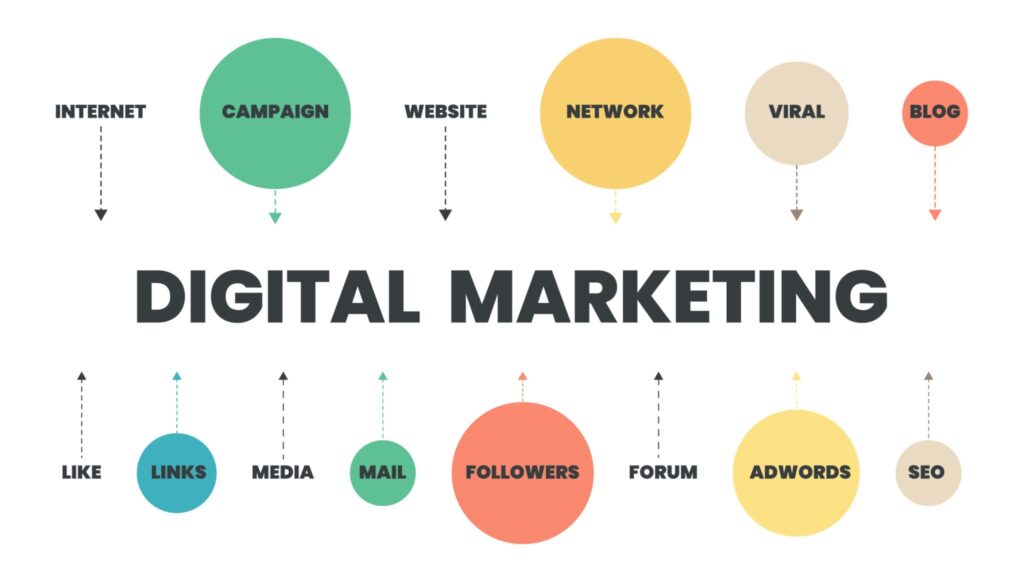
Modern commerce relies entirely on how effectively brands establish, scale, and refine their online presence. Digital marketing encompasses every strategic effort that leverages digital channels, connected devices, and the internet to reach target audiences, foster engagement, drive conversions, and retain loyal customers.
Unlike traditional promotional methods—such as print advertising, billboards, or linear television commercials—digital marketing provides measurable real-time data, granular target audience segmentation, and adaptable campaign optimizations. Whether operating a local service business, an enterprise SaaS platform, or an e-commerce brand, mastering digital marketing is essential for sustainable revenue growth.
. What Is Digital Marketing?
At its core, digital marketing is the strategic deployment of promotional campaigns across electronic media and digital devices. It bridges the gap between customer awareness and purchase intent through tailored online communications.
Digital Marketing vs. Traditional Marketing
The fundamental shift from traditional to digital marketing centers on interactivity, data accuracy, and cost-efficiency:
- Targeting Precision: Traditional channels reach broad audiences without guaranteed relevance. Digital marketing allows advertisers to target precise demographics, search intents, behaviors, job titles, and geographical boundaries.
- Two-Way Interaction: Traditional marketing relies on broadcast messaging. Digital platforms enable real-time feedback, social listening, community management, and instant customer service.
- Measurability: Calculating exact return on investment (ROI) for direct mail or print is challenging. In digital marketing, every click, impression, lead, sale, and user path is tracked through analytics tools.
- Agility: A print ad cannot be modified once published. Digital campaigns allow continuous testing and budget optimization mid-stream.
2. The Core Pillars of Digital Marketing
A resilient strategy relies on a multi-channel ecosystem where organic and paid channels support each other.
A. Search Engine Optimization (SEO)
SEO is the process of optimizing web pages, site architecture, and content to achieve higher rankings on search engine results pages (SERPs) for targeted search terms. High organic visibility builds credibility and drives cost-effective inbound traffic over the long term.
- On-Page SEO: Involves optimizing visible page elements including title tags, meta descriptions, header structure ($H_1, H_2, H_3$), internal linking, keyword frequency, and comprehensive content coverage.
- Off-Page SEO: Focuses on establishing site authority and trust through quality backlink acquisition, brand mentions, guest contributions, and digital PR.
- Technical SEO: Ensures search engine crawlers can index and render the site efficiently. Key aspects include site speed, mobile responsiveness, SSL security, XML sitemaps, structured data (schema markup), and canonical tags.
B. Content Marketing
Content marketing focuses on creating and distributing valuable, relevant, and consistent material to attract and retain a clearly defined audience. Rather than pitching products directly, content marketing addresses user pain points, answers questions, and guides prospects through the buyer’s journey.
- Blog Posts & Guides: Address top-of-funnel (TOFU) informational searches and build domain authority.
- Whitepapers & Ebooks: Function as middle-of-funnel (MOFU) lead magnets to capture contact details.
- Case Studies & Testimonials: Provide bottom-of-funnel (BOFU) social proof that validates purchasing decisions.
- Video & Multimedia: Enhance user engagement metrics and cater to varied learning preferences.
C. Search Engine Marketing (SEM) & Pay-Per-Click (PPC)
PPC advertising delivers immediate traffic by placing sponsored ads at the top of search engine results or across ad networks. Advertisers pay only when a user interacts with the ad.
- Google Ads & Bing Ads: Capture high-intent searches matching transactional keywords.
- Quality Score: Search engines evaluate ad relevance, landing page experience, and expected click-through rate (CTR) to determine ad placement and cost-per-click (CPC).
- Bidding Strategies: Ranging from manual CPC bidding to automated Smart Bidding powered by machine learning algorithms that target target CPA (Cost Per Acquisition) or target ROAS (Return On Ad Spend).
. What Is Digital Marketing?
At its core, digital marketing is the strategic deployment of promotional campaigns across electronic media and digital devices. It bridges the gap between customer awareness and purchase intent through tailored online communications.
Digital Marketing vs. Traditional Marketing
The fundamental shift from traditional to digital marketing centers on interactivity, data accuracy, and cost-efficiency:
- Targeting Precision: Traditional channels reach broad audiences without guaranteed relevance. Digital marketing allows advertisers to target precise demographics, search intents, behaviors, job titles, and geographical boundaries.
- Two-Way Interaction: Traditional marketing relies on broadcast messaging. Digital platforms enable real-time feedback, social listening, community management, and instant customer service.
- Measurability: Calculating exact return on investment (ROI) for direct mail or print is challenging. In digital marketing, every click, impression, lead, sale, and user path is tracked through analytics tools.
- Agility: A print ad cannot be modified once published. Digital campaigns allow continuous testing and budget optimization mid-stream.
2. The Core Pillars of Digital Marketing
A resilient strategy relies on a multi-channel ecosystem where organic and paid channels support each other.
A. Search Engine Optimization (SEO)
SEO is the process of optimizing web pages, site architecture, and content to achieve higher rankings on search engine results pages (SERPs) for targeted search terms. High organic visibility builds credibility and drives cost-effective inbound traffic over the long term.
- On-Page SEO: Involves optimizing visible page elements including title tags, meta descriptions, header structure ($H_1, H_2, H_3$), internal linking, keyword frequency, and comprehensive content coverage.
- Off-Page SEO: Focuses on establishing site authority and trust through quality backlink acquisition, brand mentions, guest contributions, and digital PR.
- Technical SEO: Ensures search engine crawlers can index and render the site efficiently. Key aspects include site speed, mobile responsiveness, SSL security, XML sitemaps, structured data (schema markup), and canonical tags.
B. Content Marketing
Content marketing focuses on creating and distributing valuable, relevant, and consistent material to attract and retain a clearly defined audience. Rather than pitching products directly, content marketing addresses user pain points, answers questions, and guides prospects through the buyer’s journey.
- Blog Posts & Guides: Address top-of-funnel (TOFU) informational searches and build domain authority.
- Whitepapers & Ebooks: Function as middle-of-funnel (MOFU) lead magnets to capture contact details.
- Case Studies & Testimonials: Provide bottom-of-funnel (BOFU) social proof that validates purchasing decisions.
- Video & Multimedia: Enhance user engagement metrics and cater to varied learning preferences.
C. Search Engine Marketing (SEM) & Pay-Per-Click (PPC)
PPC advertising delivers immediate traffic by placing sponsored ads at the top of search engine results or across ad networks. Advertisers pay only when a user interacts with the ad.
- Google Ads & Bing Ads: Capture high-intent searches matching transactional keywords.
- Quality Score: Search engines evaluate ad relevance, landing page experience, and expected click-through rate (CTR) to determine ad placement and cost-per-click (CPC).
- Bidding Strategies: Ranging from manual CPC bidding to automated Smart Bidding powered by machine learning algorithms that target target CPA (Cost Per Acquisition) or target ROAS (Return On Ad Spend).

3. Channel Comparison: Organic vs. Paid vs. Owned
Selecting the right balance of media types ensures stable traffic and predictable pipeline growth.
| Channel Category | Key Channels | Primary Objectives | Advantages | Strategic Trade-offs |
|---|---|---|---|---|
| Organic Channels | SEO, Organic Social, Unpaid Content | Long-term traffic, search authority, trust building | Compounding traffic value over time; low marginal cost per visitor | Takes months to yield substantial results; susceptible to algorithm updates |
| Paid Channels | PPC Search Ads, Paid Social, Programmatic Displays | Immediate lead acquisition, product launches, remarketing | Fast audience reach; hyper-targeted positioning; predictable scaling | Traffic stops immediately when budget ends; rising advertising costs (CPM/CPC) |
| Owned Channels | Email Lists, Company Website, Mobile Apps, SMS | Retention, conversion optimization, customer LTV | Full control over messaging, user experience, and subscriber data | Requires upfront audience acquisition through organic or paid channels |
4. Crafting a Data-Driven Digital Marketing Strategy
Launching individual tactics without a unified framework leads to fragmented budgets and poor conversion rates. A disciplined campaign deployment follows six distinct steps:
- Define Buyer Personas: Establish detailed profiles representing primary customers, outlining their demographics, professional roles, pain points, core drivers, and preferred media platforms.
- Establish SMART Goals: Align marketing objectives directly with business KPIs. Ensure targets are Specific, Measurable, Achievable, Relevant, and Time-bound (e.g., “Increase organic lead conversions by 35% over two quarters”).
- Conduct Competitive Gap Analysis: Evaluate competitor search visibility, backlink profiles, ad creatives, content cadence, and conversion funnels to identify market gaps and differentiation opportunities.
- Map Content to the Buyer’s Journey:
- Awareness (TOFU): Educational blog posts, informational videos, industry reports.
- Consideration (MOFU): Comparison tables, vendor evaluation guides, live webinars.
- Decision (BOFU): Product demos, pricing calculators, free trials, client testimonials.
- Allocate Budget & Stack Tools: Distribute capital across channels based on historical CAC (Customer Acquisition Cost) and select key tools for CRM (HubSpot, Salesforce), analytics (Google Analytics 4), SEO (Ahrefs, Semrush), and automation (Marketo, Klaviyo).
- Implement Continuous A/B Testing: Regularly evaluate ad headlines, landing page call-to-action (CTA) placements, email subject lines, and creative formats to continuously optimize conversion rates.
5. Key Metrics and KPIs to Measure Success
Measuring performance requires focusing on actionable outcome metrics rather than vanity signals.
- Customer Acquisition Cost (CAC): Total sales and marketing spend divided by total new customers acquired during a given timeframe:CAC=New Customers AcquiredTotal Marketing & Sales Spend
- Customer Lifetime Value (LTV): The estimated total revenue a customer generates over the entire duration of their relationship with the business. A healthy digital marketing model typically maintains an LTV:CAC ratio of 3:1 or higher.
- Return On Ad Spend (ROAS): Evaluates the direct efficiency of paid ad investments:ROAS=Total Spend on AdsRevenue Generated from Ads
- Conversion Rate (CR): The percentage of users who complete a desired action (form submission, purchase, sign-up) relative to total visitors.
- Click-Through Rate (CTR): Measures ad or search result engagement by dividing total clicks by total impressions.
6. Emerging Trends in Digital Marketing
The landscape continues to evolve alongside advances in consumer hardware, software capabilities, and changing user preferences.
AI and Predictive Marketing Analytics
Artificial intelligence tools assist in content generation, automated bidding, multivariate testing, and predictive analytics. Machine learning models analyze historical purchase paths to forecast customer churn and optimize dynamic pricing models in real time.
Voice Search and Conversational UI
With the growth of smart speakers and voice-activated mobile assistants, content must adapt to long-tail, natural language search queries. Voice optimization focuses on conversational terms and securing featured snippet answers on SERPs.
Privacy Regulations and First-Party Data Strategies
The phase-out of third-party cookies, combined with privacy frameworks like GDPR, CCPA, and Apple’s App Tracking Transparency (ATT), has shifted focus toward first-party data strategies. Brands prioritize zero-party data collection through custom surveys, interactive quizzes, transparent opt-in forms, and brand loyalty programs.
Summary Checklist for Executing Your Strategy
To build an effective online growth engine, prioritize these execution steps:
- [ ] Conduct a technical SEO audit to ensure your site is fast, secure, and mobile-optimized.
- [ ] Build content tailored to user search intent across every stage of the buyer’s journey.
- [ ] Combine paid ads for immediate visibility with organic content for long-term growth.
- [ ] Set up end-to-end conversion tracking in your analytics software to measure LTV and CAC accurately.
- [ ] Build a permission-based first-party email list using value-driven lead magnets.
Want to build a channel-by-channel content strategy for your brand?Yes